We Built a Lead Gen Engine That Replaces an Entire Office

One engine. Thousands of leads. Zero manual searching.
We built an agentic lead generation engine that scrapes the internet, qualifies businesses against an ideal client profile, finds contact information via Apollo, and writes results to a database — all automatically. Out of 1,000 records, it found websites for a third and qualified roughly 10%. Built in two weeks instead of the traditional $1.5 million and 18 months.
Imagine an office building full of people. Each person sits at a computer, manually searching the internet for businesses, checking if they meet certain criteria, finding contact information, and entering it into a spreadsheet.
Now imagine one AI doing all of that. Simultaneously. Around the clock. For a fraction of the cost.
That's what we built.
What Does the Lead Gen Engine Do?
We created an agentic lead generation engine for a client in the health insurance industry using Cursor and MCP server connections. The engine:
- Takes a list of target organizations (in this case, Internal Marketing Organizations -- IMOs)
- Searches the internet to find businesses matching specific criteria
- Scrapes websites to verify they match the ideal client profile
- Pulls licensing information to validate credentials
- Finds contact information through Apollo integration
- Qualifies or rejects each organization based on defined rules
- Writes everything to a database for the sales team
Out of 1,000 records loaded, the system found a website for about one-third and qualified roughly 10% of those. All automatically.
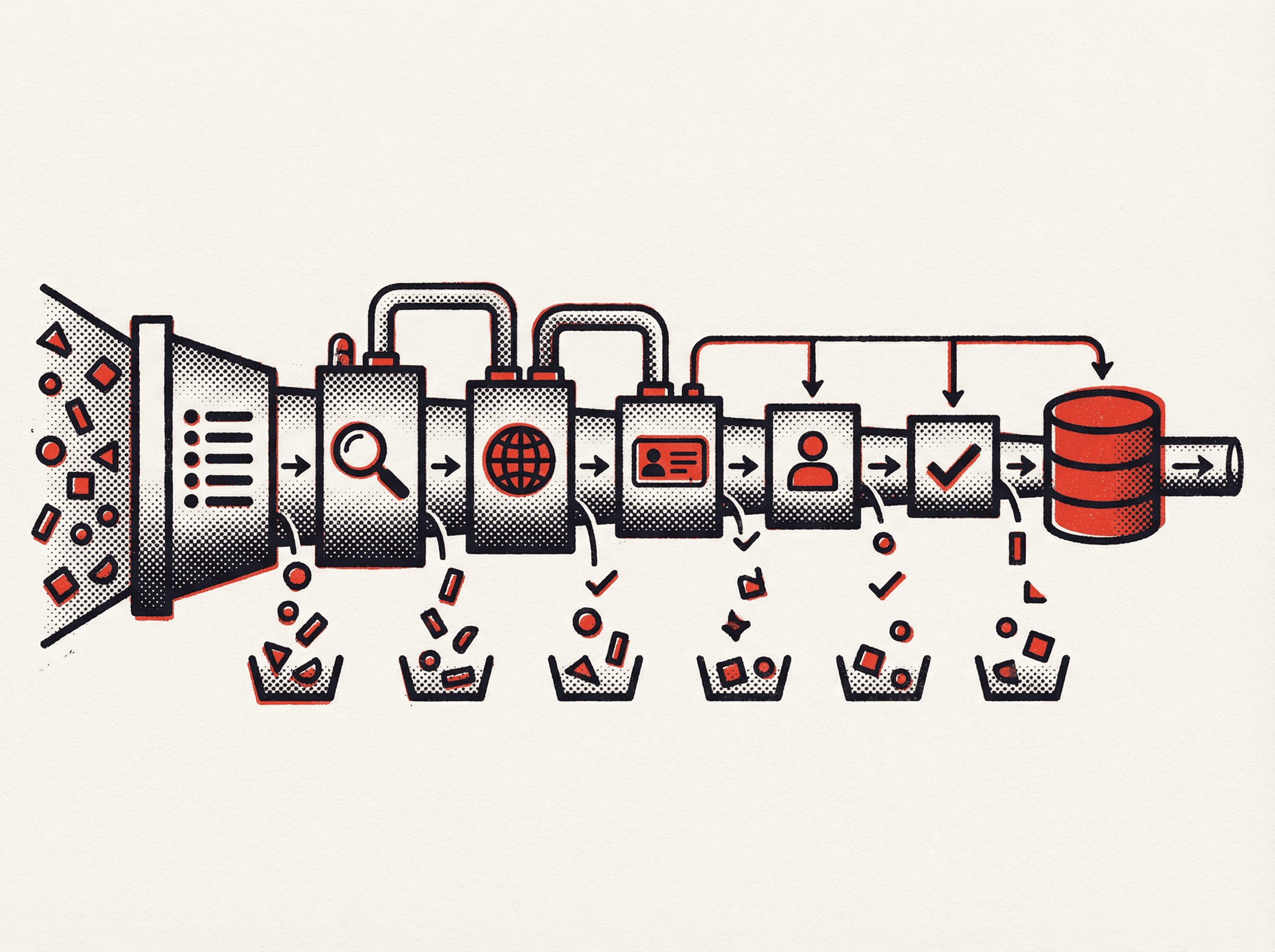
1,000 in. Qualified leads out. The pipeline does the work.
The key to building an effective lead gen engine is defining your Ideal Client Profile (ICP) clearly before you start. The more specific your criteria, the better the AI performs at qualifying versus rejecting leads. Garbage in, garbage out still applies.
The Chat Interface
The part that surprised everyone: you can talk to the database in plain English.
"How many organizations were rejected today?" "What percentage of websites were found in the last batch?" "Show me all accepted organizations in Florida."
The system converts natural language to SQL queries and returns results. No dashboard needed. No BI tool required. Just ask. We wrote about this capability in detail in Chat With Your Database.
The Cost Comparison
This engine was built in a couple of weeks. In the old development model — the kind we discuss in Old Funding Models Are Broken — product managers, designers, frontend and backend engineers, QA, DevOps -- this would have cost approximately $1.5 million and taken a year or more.

$1.5M and 18 months. Or two weeks. Same output.
The complexity isn't just the code. It's the live transaction monitoring, the data pipeline orchestration, the error handling across hundreds of concurrent web scrapes. That infrastructure used to require entire teams.
What This Means for Search
One of our community members compared this to "AI-powered SEO." But it's the opposite. SEO is reactive -- you optimize and hope people find you. This engine is proactive. It goes out, finds people, evaluates them, and brings back qualified leads.
It's not search engine optimization. It's search engine utilization.

Chris Johnston
Chris Johnston is the founder of PostScarcity AI and The Vibe Jam. Former development agency leader who managed 8 agile teams for venture-backed clients. Now teaching non-technical people to build with AI through vibe coding. Book a free Vibe Check to get started.
More About Chris Johnston