Value Rolls Up
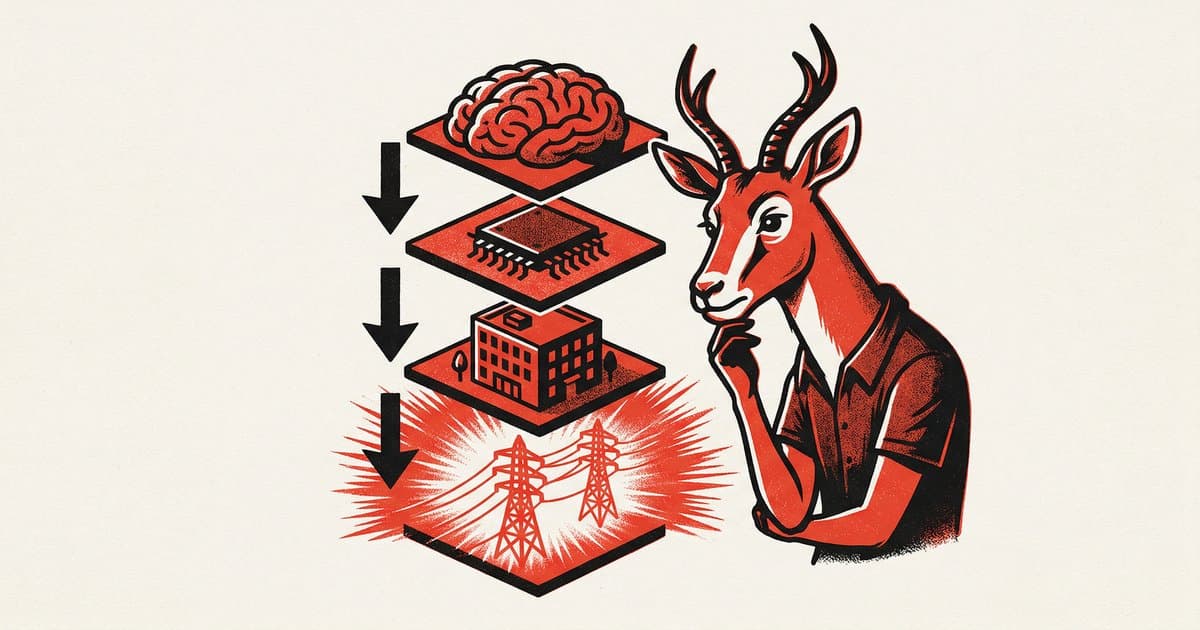
All roads lead to electrons.
The AI value chain has four layers: models at the top, chips below that, data center facilities below that, and energy at the bottom. Every layer depends on the one beneath it. Models need chips. Chips need facilities. Facilities need power and water. As AI scales, value doesn't stay at the top -- it rolls down. The ultimate winners aren't the model companies. They're the energy providers.
Everyone is focused on the top of the stack.
Which model is best. Which company raised the most money. Which chatbot passed which benchmark. The AI conversation is dominated by the names you know -- OpenAI, Anthropic, Google, Meta.
But here's a question nobody seems to be asking: where does the value actually end up?
The Stack

Four layers. Value flows down.
Think of AI as a four-layer stack.
Layer 4: Models. This is the part everyone talks about. ChatGPT, Claude, Gemini, Llama, Mistral. The software that takes your prompt and gives you an answer. The intelligence layer.
Layer 3: Chips. The models run on specialized hardware. GPUs, mostly. NVIDIA's H100s and B200s. AMD's MI300X. Custom silicon from Google (TPUs) and Amazon (Trainium). Without these chips, the models don't compute.
Layer 2: Facilities. The chips live in data centers. Massive buildings with precision cooling, redundant power, physical security, and network infrastructure. You can't just stack GPUs in a closet. They generate enormous heat and consume enormous power. They need purpose-built facilities.
Layer 1: Energy. The facilities need electricity and water. Lots of both. A single large AI data center can consume as much power as a small city. The cooling systems require millions of gallons of water. Everything in the stack above this layer -- every model, every chip, every facility -- depends on energy.
That's the stack. And value flows downward.
The Roll-Up
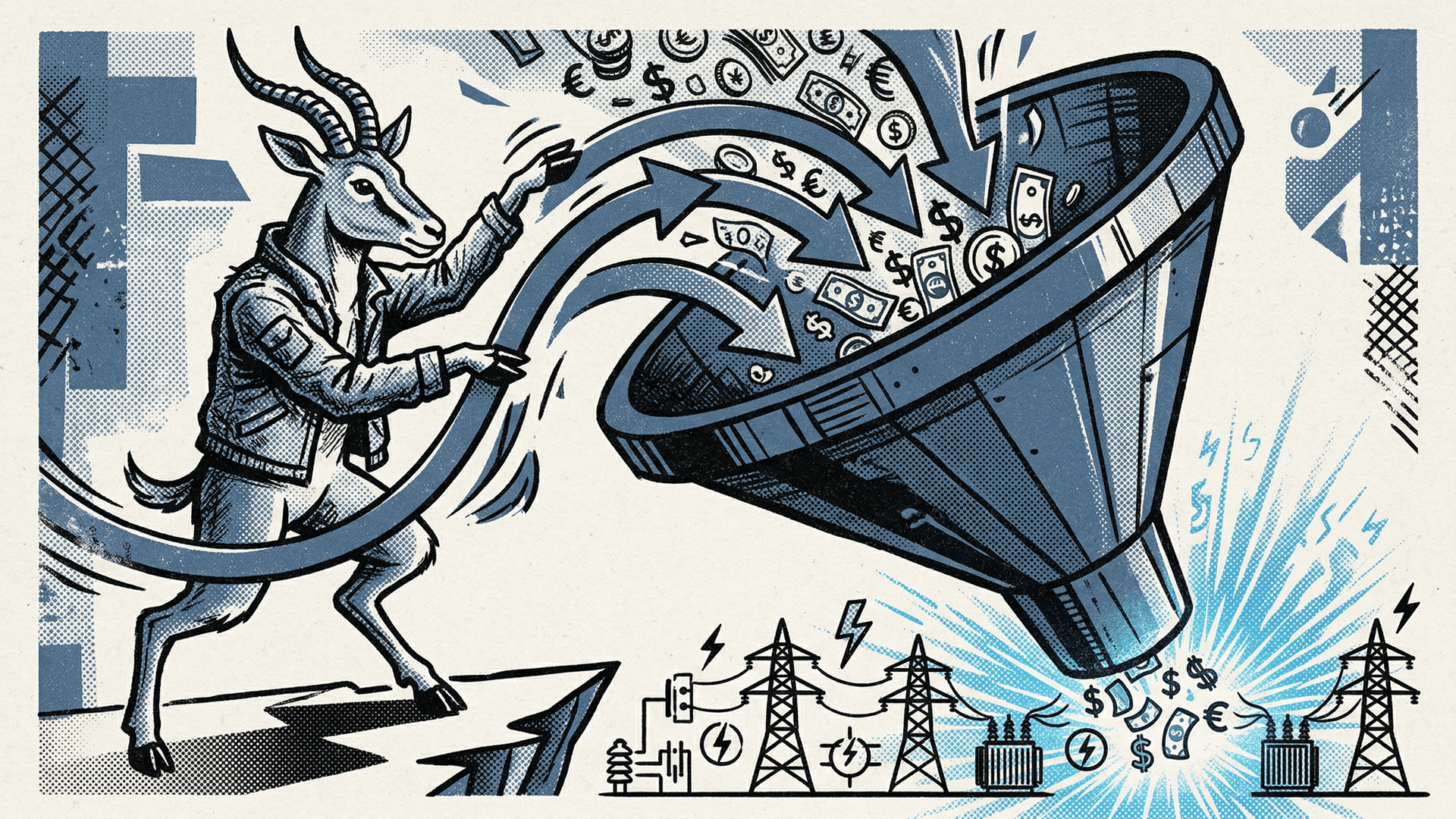
The money rolls down. Always has.
Here's how the roll-up works.
Models are becoming commoditized. OpenAI, Anthropic, Google, Meta, and dozens of open-source projects are all producing capable language models. Competition is fierce. Prices are dropping. The model layer is a race to the bottom on price and a race to the top on capability -- and that means margins get squeezed.
When model margins get squeezed, who benefits? The chip makers. NVIDIA doesn't care which model wins. They sell the shovels in the gold rush. Every model company needs their GPUs. That's why NVIDIA's market cap went vertical.
But chip makers depend on facilities. You need data centers to house the GPUs. Companies like Equinix, Digital Realty, and the hyperscalers (AWS, Azure, GCP) own and operate these facilities. As demand for chips grows, demand for facility space grows. The value rolls down.
And facilities depend on energy. Every data center needs a power contract. Every cooling system needs water. As more facilities come online, power demand surges. The energy providers -- utilities, power plant operators, renewable energy companies -- see demand they've never experienced before.
The value rolls all the way down to electrons and water molecules.
The Twilio Principle
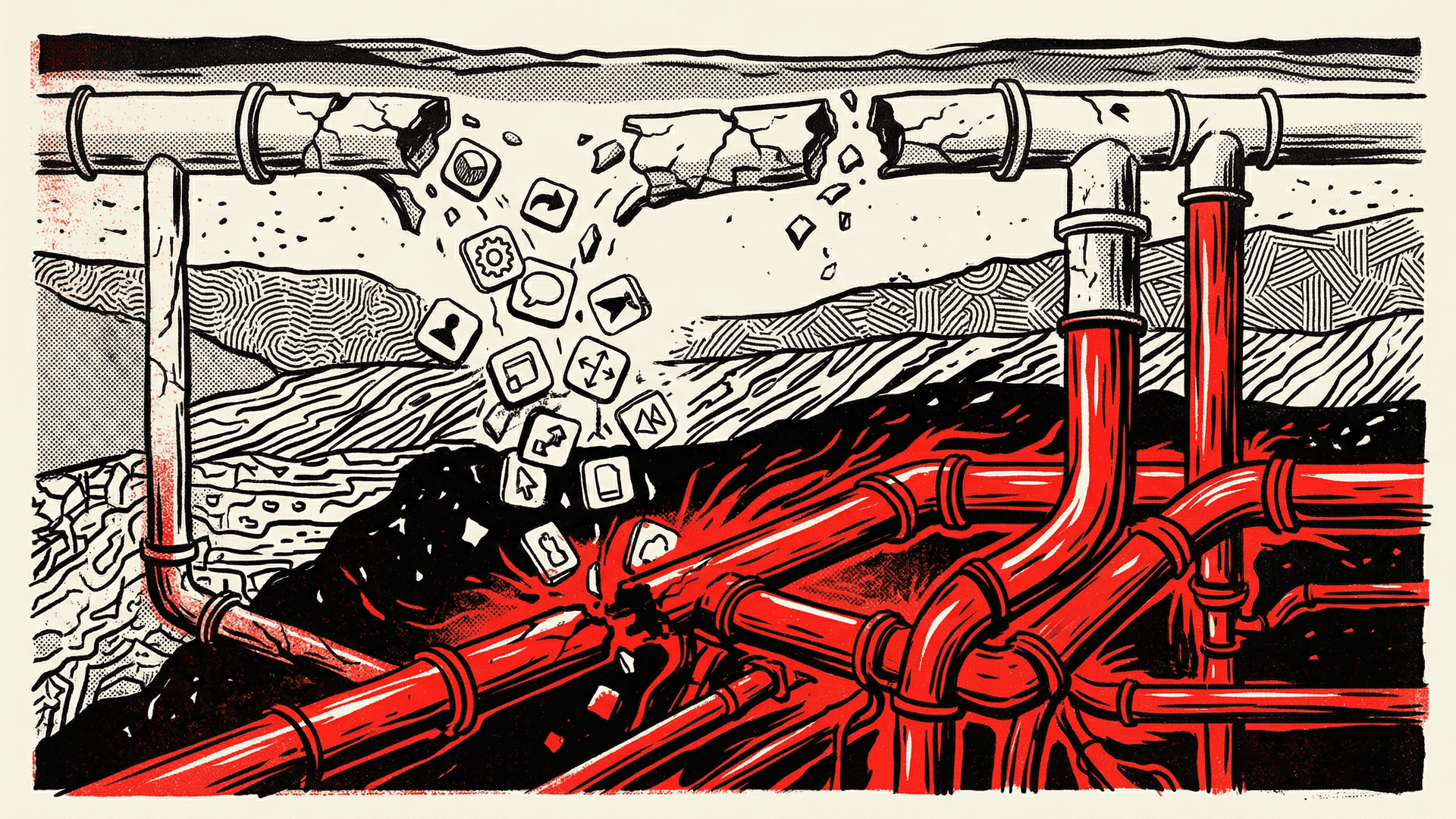
The deeper the layer, the harder it is to replace.
Before value rolls all the way down to energy, it makes a stop. Infrastructure services -- the Twilios and Stripes of the world -- are the first beneficiaries of the roll-up.
Here's why. As AI makes it trivial to build software interfaces, the interface layer collapses. MailChimp, Salesforce, HubSpot -- their value was in the interface. When that value evaporates, the infrastructure they depended on becomes more exposed. More essential. More directly accessed.
You don't need MailChimp's drag-and-drop email builder when AI can generate the email and send it through SendGrid's API directly. You don't need Salesforce's interface when AI can manage your contacts in a custom database. But you still need the email delivery infrastructure. You still need the payment processing rails. You still need the communications pipes.
Twilio, Stripe, AWS -- these companies sell access to infrastructure that can't be prompt-generated. You can't create a relationship with telecom carriers from a chatbot. You can't build payment processing compliance from a prompt. You can't conjure a data center from thin air.
The interface layer is being eaten. The infrastructure layer is being fed.
Power and Water
Here's the endgame.
Right now, everyone is arguing about which model is smartest. In five years, nobody will care. Models will be commodities. The competition will have moved down the stack.
In five years, the conversation will be about power. Which company secured the best energy contracts. Which data center operator locked in renewable power at scale. Which nation has the water resources to cool the next generation of AI infrastructure.
Microsoft is restarting nuclear reactors. Google is signing deals with geothermal startups. Amazon is investing in small modular nuclear reactors. These aren't side projects. These are existential bets. The companies building AI know exactly where the value is rolling.
It's rolling to the base layer. Power and water. Electrons and cooling. The most basic physical resources on the planet are about to become the most strategically valuable.
Models change every quarter. Chips change every year. Facilities take years to build. Energy infrastructure takes decades.
The deeper the layer, the slower it moves. And the slower it moves, the more value it captures.
All roads lead to electrons.
Wanna learn more? Join The Vibe Jam for free.

Chris Johnston
Chris Johnston is the founder of PostScarcity AI and The Vibe Jam. Former development agency leader who managed 8 agile teams for venture-backed clients. Now teaching non-technical people to build with AI through vibe coding. Book a free Vibe Check to get started.
More About Chris Johnston